
SafeCharge Drawer
A flexible charging and safety container for lithium-ion batteries.
Starting point
Lithium-ion batteries are now everywhere: tool batteries, camera batteries, drones, power banks, e-bike components, or small electronic devices often charge at the same time — spread across the workbench, floor, shelves, or power strips.
The batteries themselves are becoming ever more capable from a technical standpoint, but charging in everyday life often happens in an improvised way — power strips are lying around loosely, chargers stack up,
Cables are left plugged in permanently, defective or suspicious batteries often sit right next to working devices.
The idea for this project therefore arose less from a desire for 'more tech', but rather from the questions:
- What if a defective battery catches fire while charging?
- What could a quiet, flexible, and as universal as possible charging spot look like, without committing to specific battery types?
Not as a futuristic high-tech system, but rather as a pragmatic combination of organization, containment, monitoring, and controlled shutdown.
The approach deliberately doesn't focus on a single battery format, but on the available space.
Current status
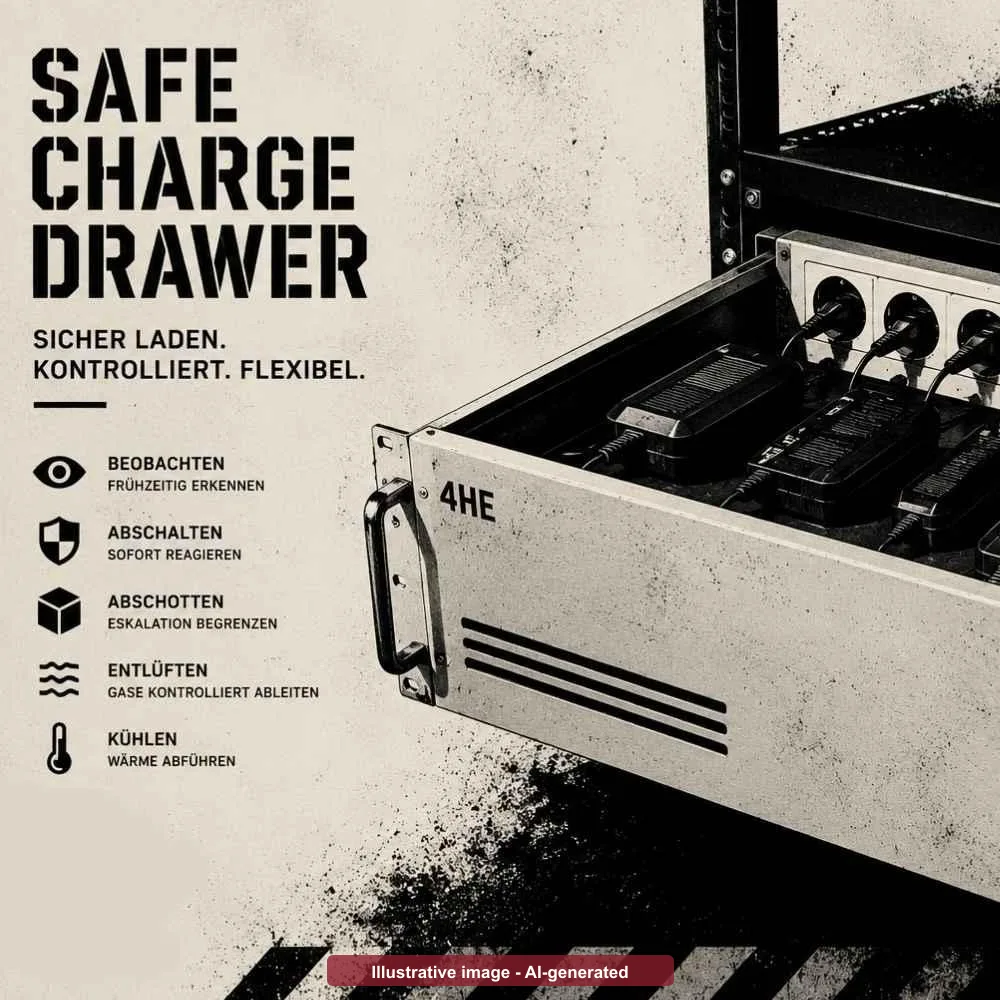
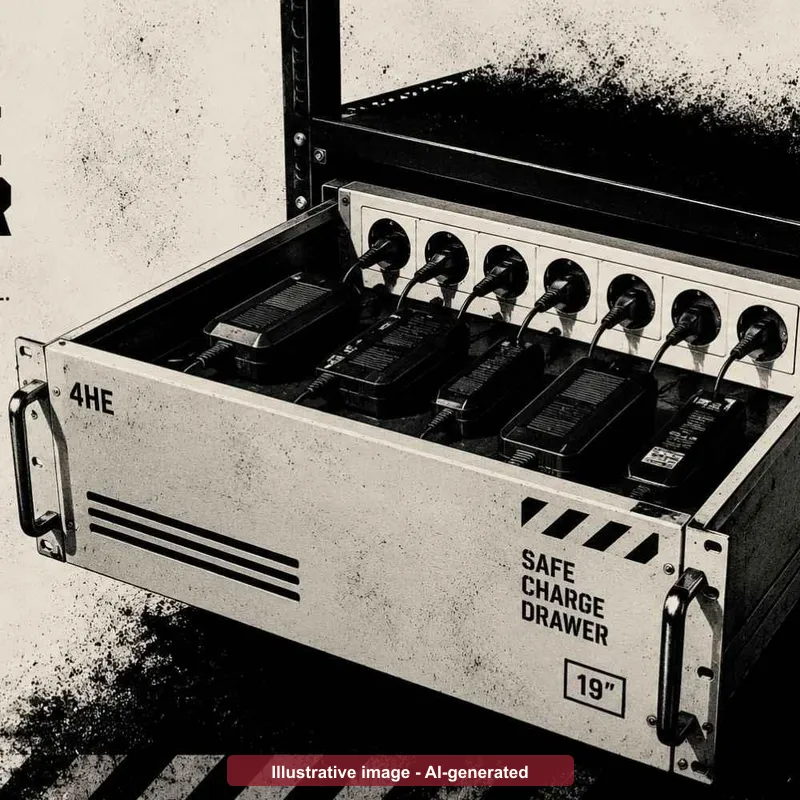
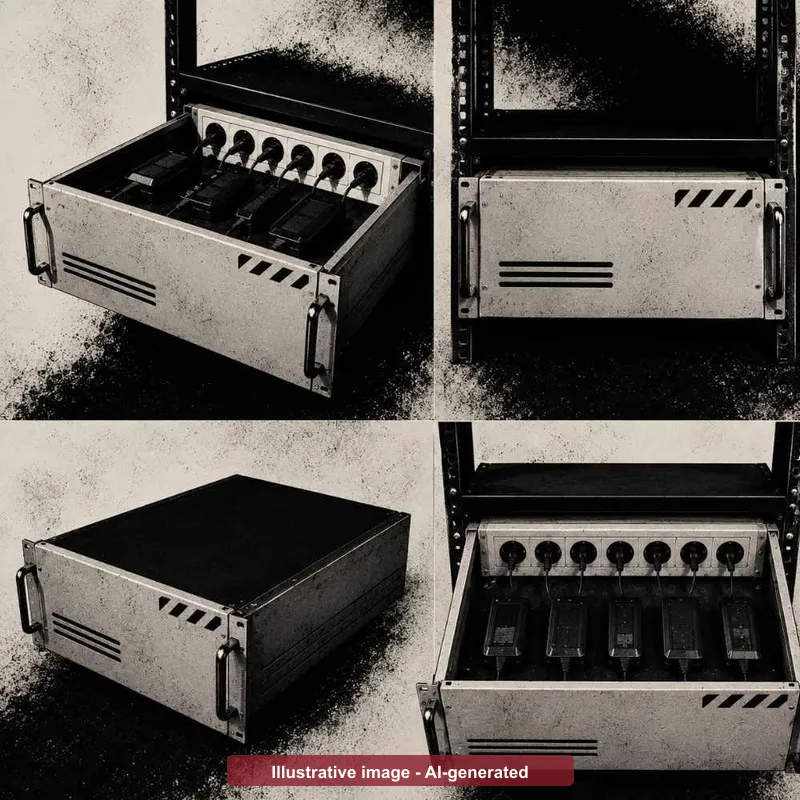
The current idea is based on a sturdy 19" steel drawer in 4U format.
Inside there are no fixed charging electronics, but standard Schuko outlets for existing original chargers. This keeps the system flexible and open to different devices and manufacturers.
The drawer does not serve as a classic 'fire extinguisher,' but rather as a controlled charging area or technical safety compartment.
Conceptually, the system consists of multiple layers:
- Flexible use,
- No fixed battery holders,
- No specialization on specific formats,
- The available space determines the use,
- Early response.
Temperature rises, smoke, or unusual developments should be detected as early as possible. In an emergency, an automatic power cutoff would be conceivable to immediately interrupt charging processes.
The example steel drawer serves as a robust outer structure to contain sparks, heat, or minor fragmentation more controllably than open solutions.
Background
The real difficulty with lithium-ion batteries is not just fire, but the combination of:
- Heat
- Pressure and gas generation
- possible chain reaction of adjacent batteries
This also changes the thinking behind the idea.
The goal is not:
"Completely extinguish a fire"
but rather:
"Detect escalation as early as possible, limit it, and keep it under better control."
Therefore, a modular steel container seems more sensible than an enclosed plastic solution or loose charging bays.
The 19-inch approach also has some interesting properties:
- standardized sizes
- robust rails
- good expandability
- stackable infrastructure
- easy integration into workshop or technical areas
This almost automatically creates a certain degree of technical order.
Notable insights
What is particularly interesting about the idea is the change of perspective:
The longer you think about lithium-ion fires, the less a classic 'extinguishing box' makes sense.
Much more relevant seems to be: controlled separation, distance, temperature management, early shutdown, pressure relief, clear structuring
The real safety gain already comes from the fact that batteries are no longer charged in an uncontrolled, scattered manner.
At the same time, it quickly becomes clear that 'completely sealed' can be problematic for a steel container. Thermal events generate gases and pressure that would need to be vented in a controlled manner. This automatically shifts the project away from a simple box toward a small system.
Send us a message if you have already found such a solution, are currently implementing one yourself, or have further input on this idea.